Everyone around me had their photographs.
Some had already put their phones away. Others were happily looking at the birds they had just captured, zooming into their screens to admire the results.
And there I stood, holding a camera with a massive wildlife lens that I had carried through days of exhausting Himalayan trekking.
Not a single photograph.
The birds were gone.
A flock of Blood Pheasants, a species I had dreamed of photographing for years, had appeared right in front of me. An opportunity I had carried nearly four kilograms of camera equipment into the mountains hoping to encounter. And I had missed it.
Not because I wasn’t close enough. Not because I didn’t have the right equipment.
But because, at that particular moment, the right equipment was inside my backpack.
It is difficult to describe that feeling. The disappointment wasn’t merely about missing a photograph. It was about everything that had led to that moment. The kilometres walked, the weight carried, the aching shoulders, the difficult terrain, and the hope that had kept me carrying a wildlife lens when there seemed to be absolutely no reason to do so.
For a few moments, I wondered whether the mountains had played a rather cruel joke on me.
But the story wasn’t over.
Because while everyone else had captured the birds, I still had something they hadn’t needed to use.
Patience. And sometimes, in wildlife photography, that makes all the difference.
Eleven Years, and a Different Pair of Eyes
This was not my first time on the Goechala trail.
I had walked it once before, eleven years earlier, and I had walked it as a very different person. Back then I was simply a trekker. I carried no camera worth the name, I knew almost nothing about birds, and the wildlife of the Eastern Himalayas was something I passed through rather than something I looked for. I remember the mountains. I remember the effort. I remember the particular silence of a high camp at night.
What I do not remember is a single bird.
Eleven years is a long time. Somewhere in those years photography found me, and then birds found me, and the two together changed the way I move through a landscape. I stopped walking in order to arrive. I started walking in order to notice.
So when the chance to return to Goechala came, I did not think of it as repeating a trek. I thought of it as finally being equipped to see it. The same trail, the same climbs, the same thin air, and a completely different reason for being there.
This time I wanted both the mountains and the birds. The light on the rhododendron slopes, the night sky above the high camps, and whatever the forest was willing to show me.
I just did not expect it to be a bird I had been hoping for since long before I owned a telephoto lens.

A Gamble That Weighed Nearly Four Kilograms
Goechala is much more than a trekking destination.
Its dense forests, rhododendron-covered slopes, high-altitude meadows and rugged mountain wilderness support an extraordinary variety of Himalayan wildlife. The wider landscape is home to the elusive Red Panda, the Red Fox, numerous pheasants and other Himalayan birds, and even the exceptionally elusive Snow Leopard in suitable high-altitude habitats.
Of course, seeing these animals on a trekking trail is another matter entirely.
I knew the chances of encountering a Red Panda were slim. A Snow Leopard? That would require a level of fortune beyond anything I could reasonably expect.
But birds? Surely, on a trail this rich in biodiversity, I would have opportunities.
That hope was enough.
Along with my Canon RF 15 to 35mm f/2.8 for landscapes, I decided to carry my Canon RF 100 to 500mm wildlife lens. It was a decision that made perfect sense to the photographer in me. To the trekker in me, however, it was almost ridiculous.
Anyone who has trekked Goechala knows how unforgiving the trail can be. Endless boulders, slippery paths, steep ascents, exhausting descents, and long hours of walking over uneven terrain. On such journeys, every gram counts.
You already have your essentials: hydration, rain protection, trail food, clothing, and everything else necessary to sustain yourself in the mountains. And then, on top of all that, imagine voluntarily adding nearly four kilograms of camera equipment.
There were moments when every additional kilogram felt like a personal enemy.
Still, I carried it. Because wildlife photography has an inconvenient truth: the most extraordinary encounter often happens when you least expect it. And the one time you leave your lens behind might be the one time you need it.
Or so I believed.

Three Days. Almost Nothing.
The first day took us towards Sachen. Beautiful forest. Wonderful surroundings. Very little wildlife. A bird or two, perhaps, but nothing that justified the effort of carrying such a heavy telephoto lens.
The second day towards Tshoka was much the same. More climbing. More difficult terrain. More weight on my shoulders. And again, hardly any wildlife encounters.
By the third day, as we climbed towards Dzongri, I was beginning to wonder whether I had miscalculated.
I did manage to spot a Himalayan Buzzard in the distance. It was hovering almost stationary in the air, beating its wings as it scanned the ground for prey. Watching its hunting behaviour was fascinating. Photographing it was another story. The bird was simply too far away for the kind of image I had hoped to make.
Meanwhile, my wildlife lens was proving surprisingly useful for photographing fellow trekkers. Which, of course, was not why I had carried it into the mountains.
Naturally, the teasing began. Why carry such a huge lens on this trail? What exactly was I expecting to photograph? Was all that weight really necessary?
I laughed along. But somewhere inside, the doubts were growing.
Three days into a demanding Himalayan trek, I had little wildlife photography to show for the effort.
Still, I refused to leave the lens behind. I had carried it this far. Perhaps the next stretch of forest would have something waiting.

The Forest Had a Surprise
The following day, we began the journey from Dzongri towards Thansing.
The trail descended steeply towards Kokchurang, passing through dense Himalayan forest. It was one of those sections where trekking demanded your complete attention. The descent was punishing, the terrain uneven, and the trail filled with rocks and boulders.
After several days of disappointing wildlife sightings, I had stopped expecting much.
My wildlife lens was packed safely inside my backpack. Instead, I had mounted the 15 to 35mm on my camera, intending to focus on landscapes and the surrounding forest.
And then, without warning, our guide Dawa pointed towards the trees.
Blood Pheasants. A whole flock of them.
For a moment, I could hardly process what I was seeing.
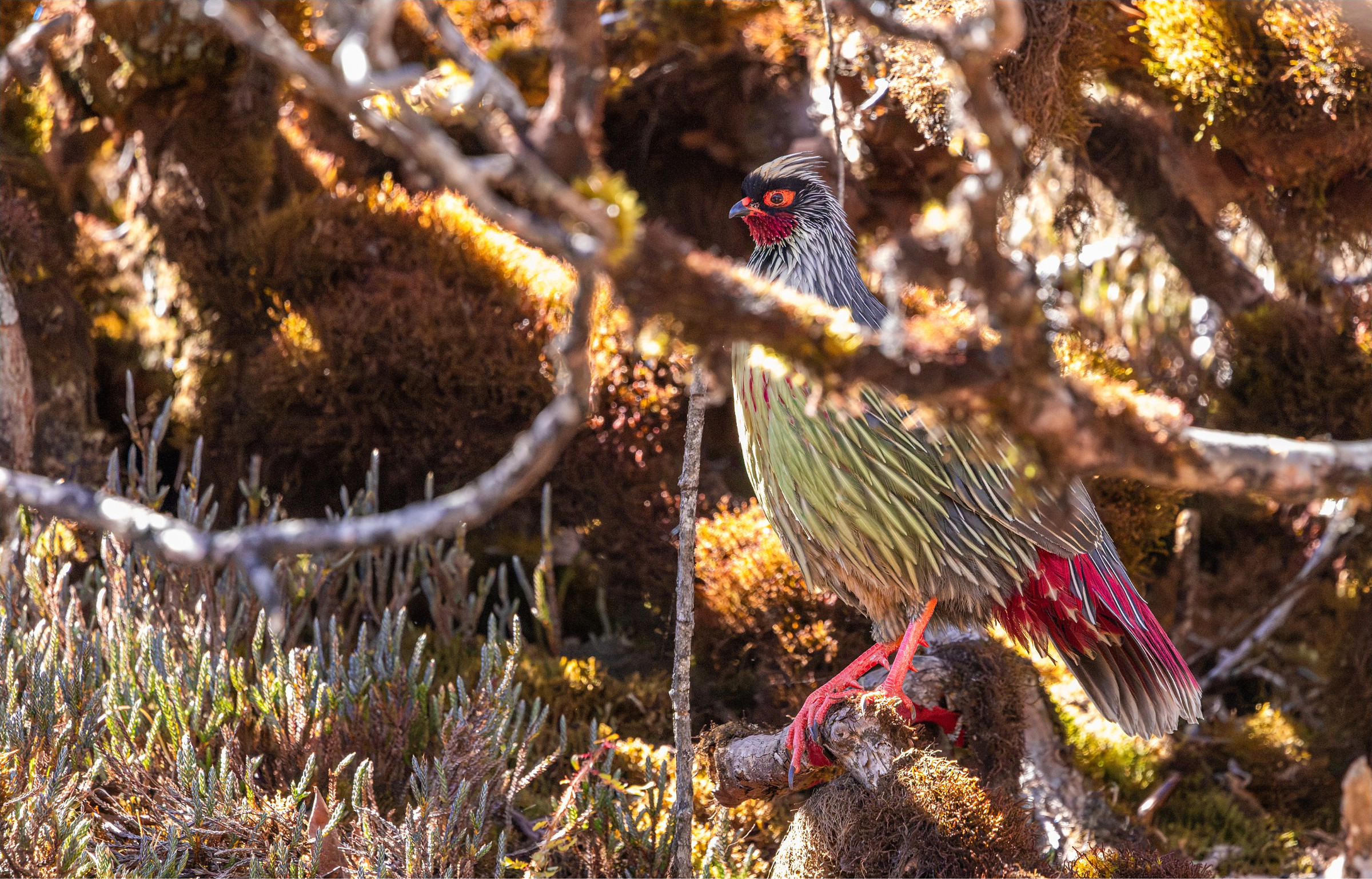
The Blood Pheasant, Ithaginis cruentus, the state bird of Sikkim, had been on my wish list for years. A magnificent Himalayan bird, the male carrying a dramatic crest, intricate silver-grey plumage, vivid red facial skin and striking crimson markings. A species I had wanted to photograph, but had never seriously expected to encounter on this trek.
And now, an entire flock was right there.
My heart raced. This was it. This was the opportunity I had been carrying that heavy lens for.
The Most Painful Lens Change of My Life
Almost immediately, my fellow trekkers began pulling out their mobile phones.
A few taps. A little zoom. Click. Click. Click.
They were photographing the birds.
Meanwhile, I had a slightly more complicated problem. My 100 to 500mm lens was inside my backpack.
I hurried to open the bag, carefully remove the telephoto lens, detach the 15 to 35mm, and mount the wildlife lens onto my camera.
Every passing second felt painfully long.
I could see people around me getting their photographs. Some of them were not particularly interested in wildlife photography. For them it was an unexpected and beautiful sighting on a Himalayan trek. For me it was a dream encounter. And yet, ironically, they were the ones capturing it.
I was still changing lenses.
By the time I finally raised my camera, ready to photograph the birds, the flock had disappeared into the dense forest.
Gone. Every single one of them. No clear view. No second opportunity. Not even one decent frame.
I was devastated.
Imagine carrying a dedicated wildlife lens through several days of gruelling trekking, only to watch someone effortlessly photograph your dream bird on a mobile phone while you struggle to assemble the very equipment you brought for that purpose.
The irony was almost unbearable.
I wasn’t upset that others had captured the birds. I was genuinely glad they had witnessed something so beautiful. But the disappointment of missing my own chance was difficult to swallow.
For a moment, I just stood there. All that weight. All that effort. All those days of hoping. And nothing.
But there was one thing I wasn’t ready to do.
Give up.
The Decision to Stay Behind
Over the years, wildlife photography has taught me that the forest operates on its own terms.
You cannot summon a bird because you have travelled a thousand kilometres. You cannot convince an animal to reveal itself because you have invested in expensive equipment. And you certainly cannot expect wildlife to wait while you change lenses.
But you can observe. You can understand the surroundings. You can recognise how human activity affects animal movement. And most importantly, you can learn when to stop moving.
I had seen the direction in which the flock disappeared.
Instead of packing my camera away and continuing towards Thansing, I kept the 100 to 500mm mounted and walked approximately a hundred metres further along the trail. Then I stopped. I found a place to sit and began watching the forest.
The trail was still busy. Trekkers were moving through. Yaks and mules carrying supplies were crossing the path. There were footsteps, voices, and the constant movement that accompanies a busy trekking route.
I had a suspicion that the birds might still be somewhere nearby. Perhaps they had retreated into the vegetation because of all the activity. Perhaps, once things became quieter, they would resume moving through the area. Or perhaps they were already far away.
I had no way of knowing. But I knew that following them noisily into the forest would accomplish very little.
So I decided to do something that sounds remarkably simple but can be surprisingly difficult when you are desperate for a photograph.
Absolutely nothing.
I sat quietly. I let the trekkers pass. I watched the yaks and mules continue along the path. I waited for the disturbance to settle.
Gradually, the sounds of movement began fading into the distance. And the forest became quiet again.
That silence was familiar to me. It is one of the reasons I love spending time in wilderness areas, often travelling far beyond comfortable surroundings to experience it.
When you sit quietly in a forest, you begin noticing things that movement often conceals. A faint rustle in the undergrowth. The movement of a branch. A distant call. The subtle signs of life continuing around you.
The forest never truly becomes silent. Rather, it begins revealing its own sounds once ours have faded.
And that was what I was waiting for.
Fifteen Minutes That Could Change Everything
My guide eventually reminded me that we had a considerable distance left to cover. He was right. Goechala is not a forgiving trail, and losing too much time on a demanding trekking day is never a good idea.
But I wasn’t quite ready to move.
I asked him to continue a little further and told him I would catch up. I needed another fifteen or twenty minutes. Just that much.
Not because I was certain the pheasants would return. Quite the opposite. I knew they might not. But something about the encounter made me believe that waiting was worth trying.
There is a particular kind of tension in wildlife photography that has nothing to do with action. It is the tension of waiting for something that might never happen.
Every minute creates a new question. Have the birds gone too far? Am I looking in the wrong direction? Should I move another fifty metres? Am I wasting precious trekking time? Would it be better to accept the disappointment and continue?
And perhaps the most dangerous thought of all: what if the moment I leave is the moment they return?
So I stayed. Camera ready. Eyes scanning the forest. Listening. Waiting.
For a while, nothing happened.
And then, movement.
The Moment Everything Changed
I noticed something moving through the vegetation.
A bird emerged. A Blood Pheasant.
For a brief instant, I almost couldn’t believe it. Then another appeared. And another.
The flock was returning.
I remained seated, barely moving. This time, my camera was ready. No backpack to open. No lens to change. No frantic attempt to capture a moment that was disappearing before my eyes.
Just me, the camera, and the forest.

What had been a frustrating glimpse earlier was now unfolding into one of the most extraordinary wildlife experiences of my trekking life.
There were males and females moving through the rocky terrain.
The males were breathtaking. Their silver-grey feathers caught the light, revealing delicate patterns that almost looked hand-painted. Their dramatic crests gave them a striking appearance, while the brilliant red around their eyes and the crimson feathers near their tails stood out against the muted colours of the forest.

The females were equally captivating in a completely different way. Their warm brown plumage blended beautifully with the earth and rocks, offering a perfect example of the camouflage that helps wildlife survive in these environments.

And there they were, moving naturally through their Himalayan home. Not in an enclosure. Not at an artificially arranged photography location. But in the wild, on a remote mountain trail, exactly where they belonged.
For several minutes, I could barely contain my excitement. I photographed them as they crossed. Some paused. Some moved behind rocks. Others stood alert, seemingly assessing their surroundings.
And then something even more fascinating happened.
More Than a Sighting
A few birds settled into the dusty sections of the trail. They lowered their bodies, rubbed against the loose earth, and began spreading their feathers.
They appeared to be dust-bathing.
I watched in fascination as fine particles of dust rose around them. For birds, dust-bathing is an important part of natural feather maintenance, helping to keep plumage in condition and potentially reducing external parasites.
But for me, it was something more.

I had hoped for a photograph of a Blood Pheasant. Instead, I was witnessing their natural behaviour.
The flock was no longer merely passing through my camera frame. I was being allowed to observe a small chapter of their everyday lives.
Some of my favourite photographs from that day came from these moments. A male standing proudly among the boulders. A female pausing quietly on the trail. Several males gathered together, their magnificent plumage contrasting against the rugged terrain. And one particularly memorable male, spreading its feathers amid the swirling dust.


These were the photographs I had imagined making when I packed my wildlife lens before the trek.
But even then, there were moments when I stopped photographing. I simply watched. Because there is something deeply satisfying about observing wildlife without feeling the need to turn every second into a camera frame.
For around thirty to forty minutes, I had the extraordinary privilege of photographing and observing these magnificent Himalayan birds.
And during those minutes, something changed. I stopped thinking about the weight I had carried. I stopped thinking about the photographs I had missed. I stopped thinking about the distance I still needed to walk.
I was completely absorbed in the moment.

The Lesson Was Never About the Lens
When I eventually stood up and continued towards Thansing, I was carrying exactly the same equipment. The same camera. The same lenses. The same heavy backpack.
And yet, somehow, it all felt different.
A short while earlier, that wildlife lens had seemed like an unnecessary burden. Now it felt like one of the best decisions I had made on the entire trek.
But as I reflected on what had happened, I realised something important.
The successful encounter wasn’t simply the result of carrying a telephoto lens. After all, I had possessed that lens when the flock first appeared, and it hadn’t helped me capture a single photograph.
The real difference came afterwards. When I chose not to rush. When I allowed the trail to become quiet. When I tried to interpret the birds’ movement instead of simply following them. When I trusted the experience that years of wildlife photography had gradually given me. And when I decided that fifteen minutes of patience might be worth more than another kilometre of hurried walking.
The lens helped me capture the photographs. But patience helped me find the opportunity.
It was a lesson the mountains had delivered more effectively than any photography workshop ever could.

The Mountains Had One More Surprise
The Goechala trek continued, and so did the physical challenges. The weather became increasingly unpredictable, with snowfall adding another dimension to an already demanding journey.
Wildlife sightings remained limited.
But the Himalayas had one more surprise waiting for me.
Snow Pigeons. Flying through falling snow.
I have always loved experiencing snowfall in the mountains. There is something magical about watching an entire landscape slowly disappear beneath a blanket of white. And spotting Snow Pigeons in their natural Himalayan environment is a special experience in itself. But seeing them flying through the snowfall, moving across that cold, dramatic mountain landscape, was another kind of pleasure altogether.

I managed to capture a photograph. Not a perfect one. Perhaps not even a particularly impressive one from a technical perspective. But it was enough to preserve the memory.
Sometimes a photograph’s greatest value lies not in how sharp or spectacular it looks, but in how vividly it takes you back to the moment you experienced.
That was one of those moments.

Worth Every Gram. Worth Every Step.
By the end of the trek, I had covered roughly a hundred kilometres of demanding Himalayan terrain. Ten days of physical effort. Countless boulders. Steep climbs and descents. Unpredictable weather. And nearly four kilograms of camera equipment carried through it all.
From a purely numerical perspective, the wildlife photography return might seem modest. One extraordinary Blood Pheasant encounter. One memorable Snow Pigeon sighting in snowfall. Not exactly hundreds of remarkable wildlife photographs.
But I have never measured the success of a wildlife journey by the number of photographs on my memory card. I measure it by the experiences that stay with me.
And that afternoon near Kokchurang will stay with me for a very long time.
I will remember the excitement when Dawa first pointed towards the birds. I will remember the frustration of watching others photograph them while I struggled with my lens. I will remember the sinking feeling when the entire flock disappeared. I will remember sitting on that rocky trail as fellow trekkers, yaks and mules moved past. I will remember the forest gradually settling into quiet.
And most of all, I will remember that first movement in the vegetation. The moment when hope, almost extinguished, suddenly came alive again.
A Blood Pheasant stepping out of the forest. Then another. Then an entire flock.
I know there will be opportunities in the future to make better photographs. Perhaps I will find Blood Pheasants in softer light, against cleaner backgrounds, with even more dramatic behaviour. Perhaps those images will surpass these in technical quality.
But no photograph can replace the story behind a first encounter. And this one carries a story I will cherish for years.
Because the greatest reward wasn’t simply photographing a bird that had been on my wish list. It was discovering that after all those difficult kilometres, the moment I had been waiting for arrived only when I stopped moving.
Eleven years ago I walked this same trail and saw almost none of it. This time I went into the Himalayas carrying nearly four kilograms of equipment, hoping it would bring me closer to wildlife.
But when the opportunity finally came, it wasn’t the weight I carried that made the difference.
It was the patience I had learned to carry within me. And that, perhaps, was the greatest photograph I brought home.
